

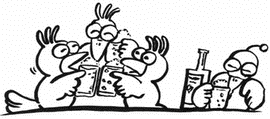
 Role models and group norms are powerful, but perhaps we have never realized how incredibly powerful they can be.
A recent study by Dr. Nicholas Christakis of Harvard Medical School and James Fowler of the University of California, San Diego, found that peers have a very strong influence on those who quit smoking. People tended to quit in clusters, creating an effect that reverberated throughout social networks. The study, published in the New England Journal of Medicine, “followed thousands of smokers and nonsmokers for 32 years, from 1971 until 2003, studying them as part of a large network of relatives, co-workers, neighbors, friends and friends of friends… As the investigators watched the smokers and their social networks, they saw what they said was a striking effect — smokers had formed little social clusters and, as the years went by, entire clusters of smokers were stopping en masse.” (NYT 5/22/08, full article here).
Similar social effects have been noted in the spread of obesity: Our peer group tends to set our norms for acceptable weight and eating patterns. If you hang out with active people whose social lives are oriented toward exercise and healthy diets, you tend to follow suit. Hang out with the fast food crowd, whose idea of exercise is making snack runs from the couch in front of the television to the fridge, you tend to get another result.
The “birds of a feather” principle applies to the mind and spirit as well. If you like hanging out with the Pity Party Pack, whose primary refrain is “Ain’t it Awful,” then you are not going to find too much social support to move your life forward around there. Matter of fact, quite the opposite. Any progress you make will be proof that their lack of progress has a strong component of personal choice.
On the other hand, if you read inspirational books with a practical bent, take relevant courses at your local junior college, join a positive community group like Toastmasters or the Jaycees, and in general choose to socialize with positive people who are determined to do something purposeful with their lives, make the most of the gifts they have been given, well, I suspect before long your life will have more meaning and oomph to it.
Our friends should always be people we like and care for. But they also should be people we respect, whose energy we enjoy being around, whose life perspective is one with which we are aligned, and that creates mutual support.
Do your friends help you move forward toward your goals? Are your peers supportive of your best dreams? Are you cheerleaders for each other? Mutual coaches and support staff in embarking on this daring adventure called life? If not, why not?
Remember the “birds of a feather” principle, and pick your friends and associates wisely because they powerfully impact your future.
—————————–